Man of Iron
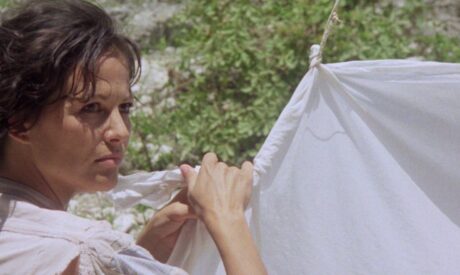
Sat 07 MarAndrzej Wajda’s rousing sequel to Man of Marble represents the most successful merger of arts and politics in Polish history — as well as Poland’s only Palme d’Or winner thus far. While that film was a fearless inquiry into the past of the Stalinist 1950s, Man of Iron is fully immersed in the present, as it not only chronicles, but also partly documents the Gdańsk shipyard strikes of 1980, which brought significant success for the emerging Solidarity movement. Only partially focused on Maciej Birkut, the son of Mateusz of the first film (both played by the brilliant Jerzy Radziwiłłowicz), Man of Iron instead portrays a bitter journalist (Marian Opania), as he navigates the political orders of his superiors and the remains of his own conscience. The film remains an exemplar of white-hot political filmmaking — and one that played at Cannes 1981 against another main competition entry designed as a Cold War parable… namely, Andrzej Żuławski’s Possession.
This film is part of the strand: Two Visions, One Nation: Wajda and Żuławski (Read more below)
Special Screening
The screening will be introduced by season curator Michal Oleszczyk
Two Visions, One Nation: Wajda and Żuławski
Andrzej Wajda was Andrzej Żuławski’s senior by 14 years, and in terms of international festival prizes (Palme d’Or, Academy Award), he seems to be the more recognized of the two. And yet, Wajda’s filmography was regularly visited, interfered with — as well as downright haunted — by the presence of his brilliant student, assistant and (ultimately) creative opponent.
Żuławski’s initial fascination with Wajda was clear in his choice of a M.A. thesis he wrote on Kanal in 1959 at IDHEC film school in Paris. Later on, he assisted Wajda on the Polish segment of Love at Twenty (1962) and on the epic Ashes (1966). From 1970 on, Żuławski turns from protégé to rival, as his progressively more frenetic films challenge Wajda’s more classical approach.
This series aims at presenting a series of double-bills that highlight the myriad ways in which Wajda’s and Żuławski’s bodies of work not only co-exist in a lively dialogue with one another, but also joyfully meet, orgiastically merge and violently clash. While both artists were different in their career trajectories and personal choices, what unites them is a fervid engagement with the vortex of Polish history, eager exploration of class and ideological conflicts of the 20th century, as well as — last but not least — the transnational dimension of their work, with Żuławski traversing the Iron Curtain as a director of alternatively Polish and French films, and Wajda engaging in multiple co-productions, in which he tried to address international audience on its own turf.
This series, while far from exploring the complete set of connections between two filmographies, is an invitation to further comparisons and explorations.
Michał Oleszczyk, Season Curator
You may also like
From the same director
From Andrzej Żuławski
See also